Starship Version 3 flew for the first time this week in a mission of several firsts, performing notably better than previous version debuts, demonstrating that the upgraded vehicle remains on track to become the workhorse Super Heavy Lift Launch vehicle for SpaceX. However, some issues require resolution before SpaceX returns to booster catches.
Flight 12:
Following a smooth countdown and propellant loading, the countdown clock paused briefly at T-40 seconds to complete final pushback operations before resuming.
Booster 19 and Ship 39 lifted off together on May 22 at 22:30 UTC from Pad 2 at Starbase in South Texas.
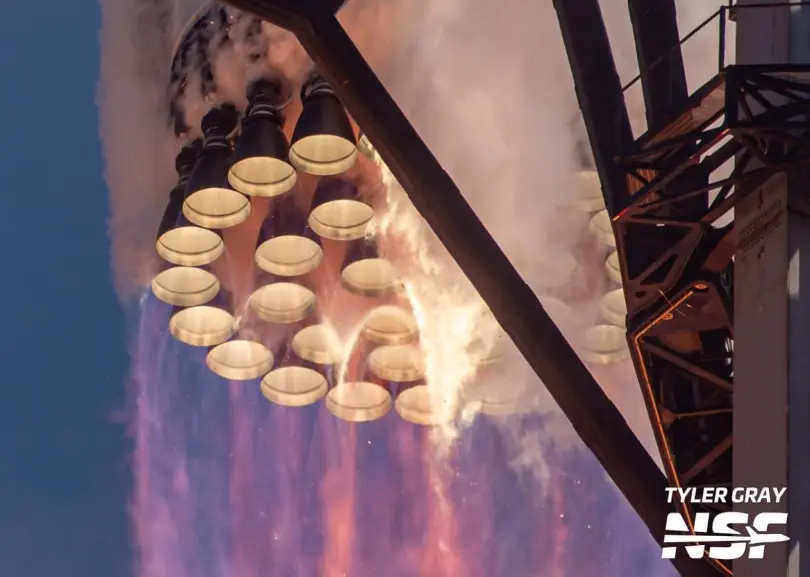
The flight carried hundreds of upgrades, including simplified and more powerful Raptor 3 engines, increased propellant capacity, and new systems designed to support Starship’s future operational goals.
The primary objective was to show that the heavily revised vehicle could still meet or exceed the performance of earlier flights.
(adsbygoogle = window.adsbygoogle || []).push({});
Booster Performance and Anomalies
Booster 19 successfully ignited all 33 of its new Raptor 3 engines at liftoff. One engine shut down roughly two-thirds of the way through ascent, but overall booster performance remained comparable to previous Raptor 2 flights.
The stack performed a dramatic 270-degree roll program immediately after clearing the launch mount to align with the proper downrange heading. This aggressive maneuver was required due to Pad 2’s different orientation compared to Pad 1.
Thanks to the new hold-down system and higher thrust from the Raptor 3 engines, liftoff was noticeably quicker than on Flight 11, giving the vehicle a significantly improved thrust-to-weight ratio.
STARSHIP FLIGHT 12
A side by side look at the the launch of Starship flight 11, the final launch on Pad 1 and Starship flight 12 the first launch of the new and improved pad, engines, and vehicles. @NASASpaceflight | https://t.co/wTIGOIV9NO pic.twitter.com/He0jveftC7— Elisar Priel (@ENNEPS) May 23, 2026
This performance boost was evident at hot staging, where the stack reached over 5,700 km/h — faster than both Version 1 (~5,300 km/h) and Version 2 (~4,700 km/h).
A key change on this flight was the hot staging sequence itself. SpaceX now retains five engines on the booster (the central three plus two from the inner ring) rather than three. The boostback burn was planned to ignite all 33 Raptor 3 engines, producing an estimated 12–13 G’s of acceleration with only about 10% propellant remaining.
However, multiple engines failed to relight at startup, accompanied by an energetic event consistent with a Raptor explosion.
Color-coding the engine config according to startup/shutdown sequences REALLY shows the impact of that single engine on the entire booster.
3 other engines failed to fully light before the energetic event. pic.twitter.com/0KdIbdWIV2
— TheSpaceEngineer (@mcrs987) May 23, 2026
The booster aborted the boostback burn and continued in a ballistic trajectory over the Gulf.
Despite the loss of control during the initial coast, the booster regained attitude authority once it reached denser atmosphere. Its grid fins demonstrated excellent control, guiding the vehicle to a stable descent. A landing burn attempt was made but also failed, resulting in a high-speed impact with the Gulf.
While the booster was lost, the flight yielded valuable data on Raptor 3 operations and grid fin performance in off-nominal conditions.
Ship 39’s Flight Profile
Ship 39 experienced an early engine-out when one RVac shut down just 36 seconds after ignition, forcing the remaining engines to burn longer. Camera views showed significant heating and damage in the engine bay, with glowing red components and sea-level engines gimbaling to compensate for the thrust imbalance.
Despite the anomaly, the ship achieved a stable coast phase using its new reaction control system vents, maintaining precise attitude control throughout. It successfully deployed all 20 Starlink V3 simulators and two modified V2 Mini “Dodger Dog” satellites equipped with cameras.
Views of Starship in space from a @Starlink satellite pic.twitter.com/5hfw1n8v1o
— SpaceX (@SpaceX) May 22, 2026
The ship used its thrusters to orient the heatshield toward the satellites for imaging, providing valuable data for future heatshield health monitoring.
The planned in-space Raptor relight was canceled due to the early engine-out. As a result, the satellites remained closer than intended during reentry, creating a striking visual of small plasma trails burning up behind the ship.
Ship 39’s reentry showcased impressive crossrange capability. Due to the off-nominal trajectory, the vehicle executed a longer entry profile and yawed significantly south, using lift not only to manage descent but also to momentarily gain altitude. Despite the demanding profile, thermal protection performed well with minimal tile loss and no visible burn-through on the flaps.
The ship survived aggressive aft flap testing and executed a notably sharper dynamic banking maneuver than seen on Flight 11. During the landing burn, it operated on two engines (transitioning to one near the end), completing a full 360-degree roll before splashing down in the Indian Ocean approximately one hour and six minutes after liftoff.
Starship flip and landing burn at the end of its twelfth flight test pic.twitter.com/0iJUox3FJt
— SpaceX (@SpaceX) May 25, 2026
Post-flight imagery revealed an exceptionally clean heatshield and beautifully tempered leeward-side stainless steel with its characteristic iridescent finish.
Regulatory Status and Future Outlook
While several items will require attention — particularly the booster’s directional flip and boostback engine startup — these are challenges SpaceX has successfully resolved in earlier iterations. The gap to a fully successful Version 3 flight appears relatively small.
The FAA is currently assessing the flight. In a statement to NASASpaceflight, the agency noted: “The anomaly involved the Super Heavy booster during its flyback over the Gulf of America. There are no reports of public injury or damage to public property. The FAA is assessing the operation. A mishap determination has not been made at this time.”
Beyond the flight itself, SpaceX made several notable announcements in the lead-up.
NASA Administrator Jared Isaacman visited Starbase during the campaign, discussing Artemis with the team.
Jared’s on the SpaceX stream, noting they may get the Artemis III SLS out on 39B for a WDR by the end of the year. pic.twitter.com/EytrPsuM2z
— NSF – NASASpaceflight.com (@NASASpaceflight) May 22, 2026
SpaceX also revealed plans for a lunar Starlink constellation using laser-linked relay satellites and confirmed that Fram2 commander Chun Wang has signed up for Starship’s first crewed interplanetary mission — a two-year Mars flyby. Wang will first fly with Dennis and Akiko Tito on the previously contracted crewed lunar flyby, potentially as early as 2034.
Starship Flight 12 has provided a wealth of data that should accelerate progress toward rapid reusability. With Version 3 now proven in flight, the path forward looks increasingly clear.
Next up will be Booster 20 and Ship 40 for Flight 13.
This mission may launch in the July-August timeframe, pending testing and any mitigation efforts relating to the issues found during Flight 12.
The launch pad appears to be in good shape, removing it from being a potential bottleneck to Booster 20’s Static Fire test, although that is not expected for weeks.
Lead Image via Tyler Gray for NSF.