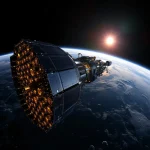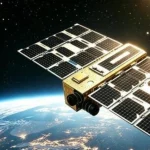
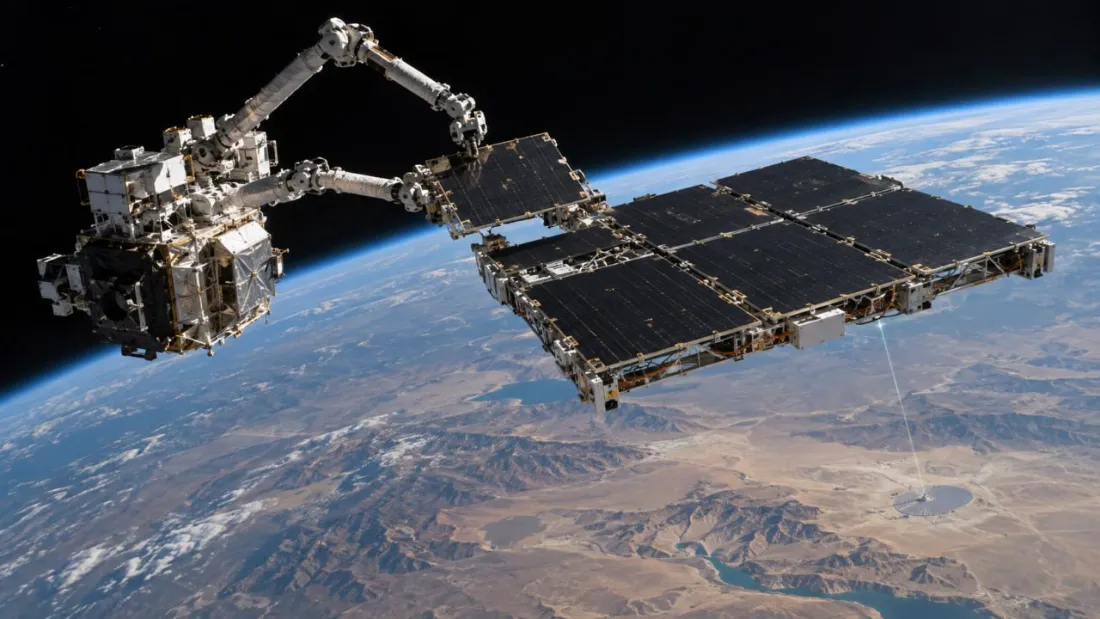
Katalyst Space has been selected by the Pentagon’s Operational Energy Capability Improvement Fund to develop and launch a robotic spacecraft that will assemble a large-format solar power-beaming system in low Earth orbit and transmit energy to Earth. Announced on September 21, the Advanced Scalable Growth Architecture for Robotic Deployment program will pair Katalyst’s NEXUS spacecraft with modular power-generation and microwave-transmission tiles under development by the U.S. Naval Research Laboratory.
Known as ASGARD, the program is intended to demonstrate both space-based power beaming and the autonomous assembly of infrastructure too large to fit inside a single launch vehicle fairing. Katalyst did not disclose the contract value, launch provider, demonstration date, expected transmitting power or location of the receiving station.
Under the planned mission architecture, the NEXUS spacecraft will launch with the NRL-developed tiles and use robotic arms to connect them in orbit. The completed structure will collect solar energy, convert the resulting direct-current electricity into radio-frequency microwave energy and direct the energy toward a receiver on Earth.
The demonstration is aimed at remote operational locations where access to conventional power generation, electrical grids or fuel supply chains may be constrained. Potential applications cited by Katalyst include military operations, disaster response and areas with damaged or limited terrestrial infrastructure. However, ASGARD remains a technology demonstration rather than an operational energy service.
Robotic Assembly Addresses Launch-Volume Constraint
Large space-based solar power systems require extensive collecting and transmitting surfaces, creating a packaging problem for conventional launches. Even if individual components can be folded, the final structure may substantially exceed the available fairing volume.
ASGARD will instead test a modular approach in which smaller elements are launched together and assembled after reaching orbit. If the method works, additional modules could eventually be delivered to expand or repair the structure without replacing the entire spacecraft.
Katalyst describes NEXUS as a multi-mission robotic platform combining mobility, object capture, manipulation and assembly. For ASGARD, those capabilities will be used to construct and operate the power-beaming array rather than service another spacecraft.
The assembly phase is therefore as important as the energy-transmission experiment. Autonomous manipulation in orbit requires accurate relative navigation, stable attitude control and reliable mechanical and electrical connections between modules. The completed array must also maintain the pointing accuracy needed to direct microwave energy toward a designated receiving site.
Thermal management and conversion efficiency will be additional constraints. Energy not converted into the transmitted beam becomes waste heat that must be rejected in vacuum, while losses during solar collection, electrical conversion, microwave generation, transmission through the atmosphere and reception determine the system’s end-to-end efficiency.
NRL Builds on Earlier Power-Beaming Tests
ASGARD follows earlier NRL work on modular space-solar hardware. In May 2020, the laboratory launched the Photovoltaic Radio-frequency Antenna Module, or PRAM, aboard the U.S. Air Force’s X-37B Orbital Test Vehicle.
The approximately 30-cm-square experiment was designed to collect sunlight and convert the resulting electrical power into radio-frequency microwave energy. PRAM evaluated the conversion process and thermal behavior in the space environment but did not beam power to Earth.
The new mission would move beyond testing an individual conversion module by combining multiple tiles into a larger structure and transmitting energy to a terrestrial receiver. It will also examine whether a servicing-class spacecraft can build infrastructure that can later be resupplied or expanded.
OECIF finances pre-commercial technologies intended to improve energy availability and resilience for U.S. military operations. Space-based power beaming could reduce reliance on fuel convoys or fixed infrastructure in some environments, but any operational system would still require suitable receiving equipment, beam-control safeguards and regulatory approval for radio-frequency transmission.
NEXUS Follows a Difficult First Servicing Mission
The selection gives Katalyst another opportunity to demonstrate its robotic spacecraft technology after the company’s LINK vehicle failed to complete a mission to raise the orbit of NASA’s Neil Gehrels Swift Observatory.
LINK launched on July 3, 2026, but later encountered persistent attitude-control problems and began spinning. NASA and Katalyst abandoned the planned capture and orbit-raising operation in August after attempts to stabilize the vehicle failed. The spacecraft nevertheless tested some electric-propulsion and robotic-arm functions before the servicing objective was canceled.
Katalyst has also been selected by the Defense Innovation Unit for a deorbit-as-a-service effort supporting the Space Development Agency, extending its work into the disposal of spacecraft at the end of their missions.
For ASGARD, the next milestones will be the completion of NEXUS and the NRL tiles, launch into low Earth orbit, robotic assembly and a controlled power transmission to a ground receiver. Those stages will determine whether the project can progress from individual component testing to an integrated, scalable space-based energy system.