

Rivada Space Networks highlights the core technology elements underpinning the next-generation low Earth orbit (LEO) satellite network. The company’s technology strategy is focused on delivering secure, high-capacity and low-latency communications for enterprise, government and institutional users through a space-based networking architecture designed to reduce reliance on terrestrial infrastructure. At the center of Rivada Space Networks’ technology is an optical inter-satellite link architecture that enables satellites within the constellation to communicate directly with one another using laser-based links.

By routing data through space, the network is designed to minimize latency and reduce exposure to terrestrial network congestion or interference. Optical links also provide high data-throughput potential and narrow beam characteristics, supporting secure point-to-point communications between satellites across the constellation. Rivada’s constellation is engineered as a space-based mesh network in which each satellite acts as a node capable of dynamically routing traffic. This architecture allows data paths to be optimized in real time based on network conditions, mission priorities and destination requirements. By operating as a self-routing network in orbit, the system is designed to provide consistent performance across global regions, including remote or underserved areas where ground infrastructure may be limited or unavailable.
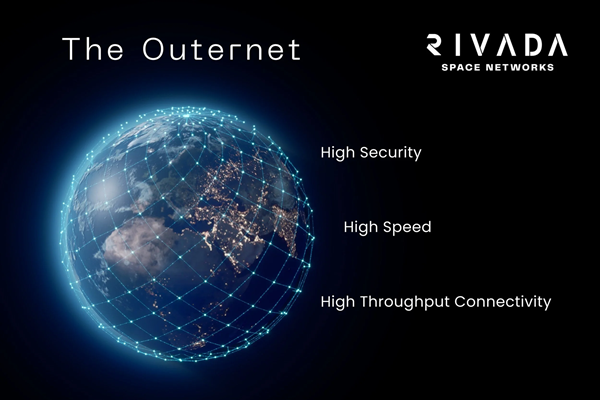
Security is a foundational design consideration across Rivada Space Networks’ technology stack. The space-based routing model limits the number of ground touchpoints required for data transmission, reducing potential attack surfaces. Combined with encrypted communications and controlled access to network resources, the architecture is intended to support customers with stringent security and data-sovereignty requirements, such as government agencies, defense organizations and critical infrastructure operators. While the constellation emphasizes in-space data transport, Rivada’s technology also includes a ground segment designed to integrate securely with customer networks. Gateway stations and network management systems are structured to interface with existing enterprise and government infrastructure, enabling users to route traffic between terrestrial networks and the LEO constellation without complex customization. This integration approach supports interoperability with modern cloud environments and private networks while maintaining centralized control and monitoring.
Rivada Space Networks’ technology is designed to scale as constellation capacity expands. The network architecture supports incremental growth, allowing additional satellites to enhance coverage, redundancy and throughput over time. This scalability enables the company to address evolving customer demand across sectors such as global enterprises, financial services, energy, maritime operations and institutional communications, without requiring fundamental changes to the underlying system design. By combining optical inter-satellite links, a space-based mesh network and a security-focused design philosophy with technology supports a communications model designed to modern and data-intensive applications.

The company’s approach reflects a shift toward satellite networks that function as integral extensions of global digital infrastructure, providing predictable performance, resilient connectivity and enhanced security for users operating across international and mission-critical environments. Through continued development of the technology platform, Rivada Space Networks is positioning the LEO constellation as a foundational layer for next-generation satellite communications services that prioritize security, performance and global reach.
About Rivada Space Networks
Rivada Space Networks is a satellite communications company focused on delivering secure, high-capacity global connectivity through a next-generation low Earth orbit (LEO) satellite network. Headquartered in München (Munich), Germany, Rivada Space Networks is developing a space-based infrastructure designed to support enterprise, government and institutional users with data services that prioritize security, resiliency, and predictable performance. The company’s planned LEO constellation is designed around an optical inter-satellite link (OISL) architecture, enabling data to be routed directly through space. This approach is intended to reduce latency, enhance data security and provide end-to-end connectivity. The system architecture is designed for applications that require assured communications, including government networks, critical infrastructure, financial services and global enterprises with distributed operations. By combining space-based networking, optical communications, and a managed service delivery model, Rivada Space Networks aims to offer scalable and secure satellite connectivity aligned with modern cloud, data and mission-critical communication requirements.