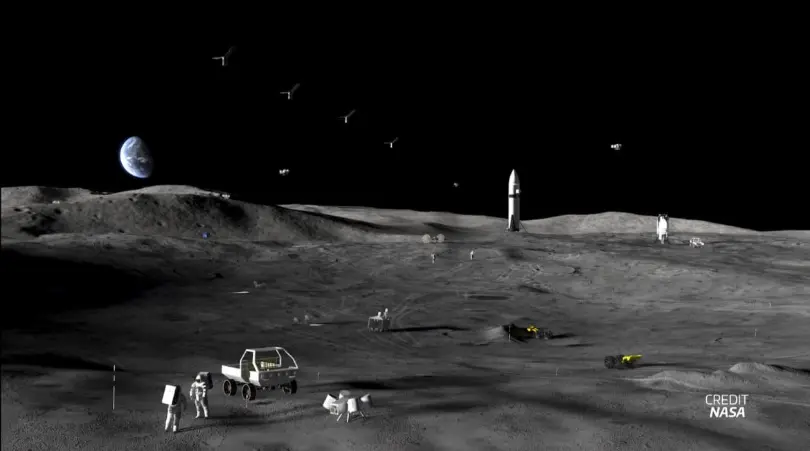
NASA has outlined the initial missions under its Moon Base initiative, rebranding existing Commercial Lunar Payload Services (CLPS) flights, while also awarding contracts for the first crewed Lunar Terrain Vehicles (LTVs) intended to support surface operations as early as 2028.
The agency confirmed that the first three Moon Base missions are adaptations of previously planned CLPS deliveries, now integrated into the broader lunar surface architecture.
Moon Base I: Blue Origin Blue Moon MK1 Endurance
Moon Base I will be the maiden flight of Blue Origin’s Blue Moon MK1 lander, named Endurance. This uncrewed mission serves as the first of two test flights to validate technologies for the larger crewed Blue Moon MK2 lander.
The lander will demonstrate its BE-7 engine in flight for the first time, along with power and propulsion systems, avionics, and precision landing capabilities.

Scientific payloads include the SCALPSS camera suite to image engine plume-regolith interactions and a Laser Retroreflector Array to support improved navigation.
The targeted landing site is the Shackleton Connecting Ridge near the lunar south pole, a region of high interest due to the presence of water ice in permanently shadowed craters.
Endurance is currently undergoing pre-flight testing at Blue Origin’s facilities at Kennedy Space Center, with launch targeted no earlier than the third quarter of 2026.
SpaceX
(adsbygoogle = window.adsbygoogle || []).push({});
Moon Base II: Astrobotic Griffin Mission One
Moon Base II will fly Astrobotic’s Griffin lunar lander on its maiden voyage.

Griffin follows their previous unsuccessful Peregrine Mission One, which experienced a propellant leak shortly after launch on United Launch Alliance’s Vulcan Centaur and did not reach the lunar surface.
Griffin is manifested to deliver more than 500 kg of payload, including two rovers. One is Astrolab’s FLIP rover, designed to test technologies for future crewed lunar mobility.

Moon Base II is scheduled for launch no earlier than the fourth quarter of 2026 aboard a SpaceX Falcon Heavy.
Moon Base III: Intuitive Machines Nova-C IM-3
Moon Base III is Intuitive Machines’ third Nova-C lander flight, following the IM-1 and IM-2 missions. The lander, named Trinity, will carry international partner payloads along with the Lunar Vertex science investigation, which will study lunar swirls—high-albedo surface features whose formation mechanisms remain under investigation.
 Nova-C landers have previously achieved soft landings but tipped over on both prior missions. Moon Base III is targeted for launch no earlier than the fourth quarter of 2026 on a SpaceX Falcon 9, sharing the ride with additional payloads.
NASA indicated that more than a dozen additional Moon Base missions will be announced later this year as part of the continuing CLPS program.
Lunar Terrain Vehicle Awards
NASA has awarded task orders to Astrolab and Lunar Outpost for the development of crewed Lunar Terrain Vehicles under the scaled-down LTV program.
 Astrolab received a $219 million award for its Crew Lunar Vehicle (CLV-1) rover, derived from the FLEX rover architecture. Lunar Outpost was awarded $220 million for its Pegasus rover, an evolution of the earlier Eagle design.
Both vehicles have been resized from earlier van-scale concepts to approximately one metric tonne to align with current lander capabilities.
 The rovers are designed for speeds of more than 9 km/h (CLV-1) and 14 km/h (Pegasus). They will support crewed driving, teleoperation from Earth, and autonomous operation.
Delivery to the lunar surface is planned via Blue Origin’s Blue Moon MK1 lander using a crane system for offloading.

The vehicles will conduct remote operations ahead of the first crewed Artemis landing to scout terrain and reduce risk.
The revised timeline targets the first LTV for Artemis IV, the initial crewed lunar landing now planned for 2028.
Supporting MoonFall Drones
To improve surface reconnaissance beyond the capabilities of the Lunar Reconnaissance Orbiter (LRO), NASA is preparing MoonFall drones—small, 250 kg hoppers developed by the Jet Propulsion Laboratory based on Ingenuity heritage.
Firefly Aerospace has been contracted to deliver three or four MoonFall vehicles to the Moon in 2028 using an Elytra space tug.

The drones will separate mid-flight, perform their own landings, and conduct high-resolution mapping with up to 10 HD cameras during a single lunar day.
At the conclusion of operations, they will position themselves to mark the perimeter of the future Moon Base site and carry survive-the-night payloads, allowing for the drones to wake up when the sun rises – but they will never fly again.
 Looking Ahead
NASA expects additional CLPS 1.0 and 2.0 task order opportunities in the coming months as part of Phase 1 of the Moon Base program.
The crew for Artemis III is scheduled to be announced on June 9 at Johnson Space Center in Houston.
(Lead Image via NASA).