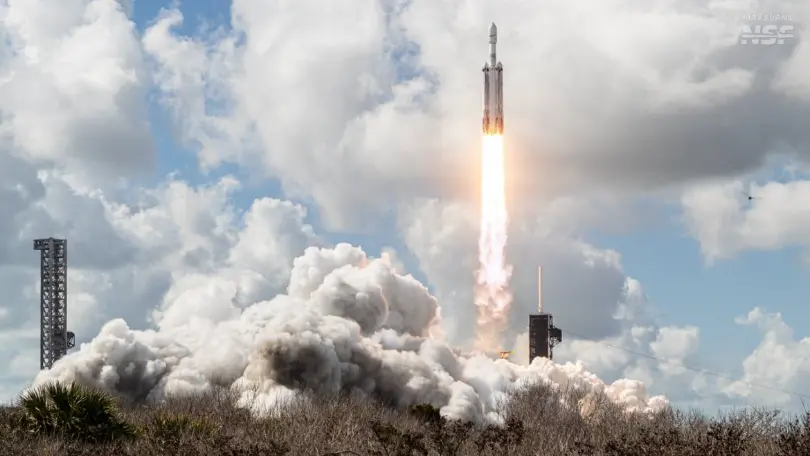
After a hiatus of more than a year and a half, SpaceX’s Falcon Heavy rocket finally flew again from historic Launch Complex 39A (LC-39A) at the Kennedy Space Center (KSC) in Florida. The mission, named ViaSat-3 F3, saw a third internet satellite deployed as part of the ViaSat-3 internet satellite constellation into geostationary orbit (GEO).
Falcon Heavy launched on Wednesday, April 29, at 10:13 AM EDT (14:13 UTC). During the mission, the two side boosters completed a return to launch site (RTLS) landing at Landing Zone 2 (LZ-2) and Landing Zone 40 (LZ-40) at the Cape Canaveral Space Force Station (CCSFS) a short distance from where they launched. The center booster was expended.
The first launch attempt, scheduled for Monday, April 27, was scrubbed due to poor weather conditions.
Payload
ViaSat-3 F3, as the name implies, is the third and currently final in a series of Ka-band internet satellites. The first, ViaSat-3 F1, was launched in May 2023, also aboard a Falcon Heavy rocket, to provide internet coverage to the Americas. F2 was launched in November 2025 aboard a United Launch Alliance Atlas V 551, with its coverage area including Europe, the Middle East, and Africa.

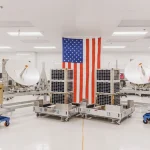
ViaSat-3 F3 seen during solar array deployment testing. Credit: ViaSat
However, following the commissioning of the first satellite, the company noticed a lower capacity than originally planned following a problem deploying one of the onboard antennas. As a result, once F2 is fully commissioned later this year, it will instead swap its coverage area with F1. This new satellite, F3, will cover the Asia-Pacific region.
See Also
- ViaSat-3 F3 Updates
- SpaceX Missions Section
- L2 SpaceX Section
- Click here to Join L2
This satellite was originally scheduled to launch aboard an Ariane 6 rocket from French Guiana. However, the launch was switched to Falcon Heavy following delays in the development of the European launcher, as well as the increased manifest Ariane 6 would face following the conflict in Ukraine and Russia.
(adsbygoogle = window.adsbygoogle || []).push({});
Ariane 6’s launch facility formerly supported Soyuz launches, which ceased flying outside of Russia and Kazakhstan following the Russian invasion of Ukraine, requiring many of those payloads to change rockets and creating a larger backlog for the Ariane 6.
The satellite is built upon a Boeing-made 702 satellite bus. While ViaSat manufactured the payload in Tempe, Arizona, Boeing’s satellite systems facility in El Segundo, California, provided the systems integration and testing, launch vehicle integration, and other operations services.
With a mass of six metric tons and capable of generating 25 kW of power, ViaSat says the satellite will add more than a terabyte per second of capacity to their current satellite network, with download speeds of more than 100 Mbps.

A render of ViaSat-3 F3 in its final orbit. (Credit: ViaSat)
The constellation is set to expand the company’s in-flight WiFi connectivity used on many commercial airliners as well as business jets. The company says it will also be used to provide connections for mariners, regular homes and businesses, and is being designed to support government and defense needs.
As with the previous ViaSat-3 payloads, this satellite will be deployed to and operate in GEO.
Falcon Heavy
Falcon Heavy is set to make its 12th flight since its debut in 2018. The most recent launch of the SpaceX heavy-lift vehicle was NASA’s Europa Clipper mission in October 2024. That mission saw all 3 boosters expended. The most recent flight to utilize a dual RTLS was GOES-U in June 2024. Following failed attempts at recovering the center core, all Falcon Heavy missions to date have expended the center core.

One of the two side boosters for the GOES-U Falcon Heavy launch inbound to a landing. (Credit: Sawyer Rosenstein for NSF/L2)
Falcon Heavy currently only launches from LC-39A, which has seen a major focus shift in recent months. SpaceX announced that Falcon 9 flights would cease from the pad, with the rocket instead launching solely out of Space Launch Complex 40 (SLC-40) at CCSFS, as well as SLC-4E on the west coast.

This allowed the company to focus on using LC-39A for Falcon Heavy operations as well as continued preparations for the first Starship flight from Florida, which will take off from a launch mount located within LC-39A’s fence line.
The center core booster for this rocket will be B1098. It first arrived at the McGregor testing facility in Texas in August 2025, as spotted on NSF’s McGregor Live 24/7 cameras. It was static fire tested in September, before being transported to Florida.
Falcon Heavy center core B1098 conducted a full duration (78s) static fire test at McGregor
Live views via @NASASpaceflight McGregor Live
— Jay Keegan (@_jaykeegan_) September 2, 2025
The side cores are B1072 and B1075, flying on their second and 22nd flights, respectively. B1072 previously flew as a Falcon Heavy side core on the GOES-U mission in June 2024, landing successfully at LZ-1. However, since that flight, SpaceX no longer holds the lease on LZ-1, and instead, this mission will land at the new LZ-40. This will be the third-ever landing at this new landing zone, which saw its first use on the Crew-12 mission in February 2026.
B1075 has previously launched SDA-0A, SARah-2, Transporter-11, and 18 Starlink missions. While SpaceX no longer uses LZ-2 for Falcon 9 launches, it currently still has permission to use it for Falcon Heavy missions. That’s where B1075 is expected to return to on this mission.
Countdown
Unlike Falcon 9, Falcon Heavy begins propellant load at T-50 minutes, beginning with rocket propellant 1 (RP-1), a refined form of kerosene, into the core stages. Liquid oxygen (LOX) load on the first stage begins five minutes later.
At T-18:30 minutes, with the RP-1 fully loaded on the upper stage, LOX load begins on stage 2. At T-7 minutes, the 27 Merlin engines at the base of Falcon Heavy begin their chilldown. The onboard computers take control of the count at T-1 minute with the “go” expected from the launch director 45 seconds before liftoff. Ignition occurs six seconds prior to first motion.
The two side cores will separate at approximately T+2:25 minutes when they will both flip and perform a boostback burn, slowing their forward momentum and placing them on a trajectory back to CCSFS and the two landing zones.

A timeline graphic of Falcon Heavy’s mission. (Credit: SpaceX)
The core stage will shut down and separate just before T+4 minutes, which is when the Merlin vacuum engine on the upper stage will fire up. The fairing halves separate away approximately 15 seconds later and will eventually be recovered to be flown again.
The side boosters will perform their entry burn to help thermally protect themselves as they begin to encounter the thicker parts of Earth’s atmosphere at around T+6:30 minutes. The boosters are then expected to land at their respective landing zones in a staggered manner around eight minutes after launch.
Second engine cutoff 1 (SECO-1) is expected about 13 seconds after the landings. A second burn will occur at T+26:05 minutes, lasting almost 90 seconds. A third burn is expected at T+4:47:47 hours, lasting 50 seconds. Almost five hours after launch, the Viasat-3 F3 satellite will be separated from Falcon Heavy’s upper stage, completing the mission.
(Lead image: Falcon Heavy launches from LC-39A. Credit: Max Evans for NSF)