A turbopump anomaly discovered in August will prevent Europe’s Ariane 6 rocket from completing its planned eight missions in 2026, with the annual total potentially falling to six, according to industry officials. The disruption comes as Arianespace and ArianeGroup attempt to raise the vehicle’s flight rate toward an initial operational cadence of nine to ten launches per year.
Officials expect only one or two additional Ariane 6 launches before the end of 2026. The final number will depend on whether technicians can repair the affected turbopump at the Guiana Space Center in French Guiana or must replace the component, which would require a more involved intervention and could extend the delay.
The specific engine and turbopump involved have not been publicly identified. Ariane 6 uses two liquid-hydrogen and liquid-oxygen engines: the Vulcain 2.1 on its core stage and the restartable Vinci on its upper stage. Turbopumps are high-speed assemblies that feed propellants into an engine’s combustion chamber at the pressure and flow rates required for operation, making them among the most mechanically demanding components in a liquid-propellant rocket.
An on-site repair could allow launch preparations to resume without returning major hardware to Europe. Replacing the turbopump would introduce additional work involving access to the engine, component removal and installation, inspections and verification before the vehicle can be cleared for flight.
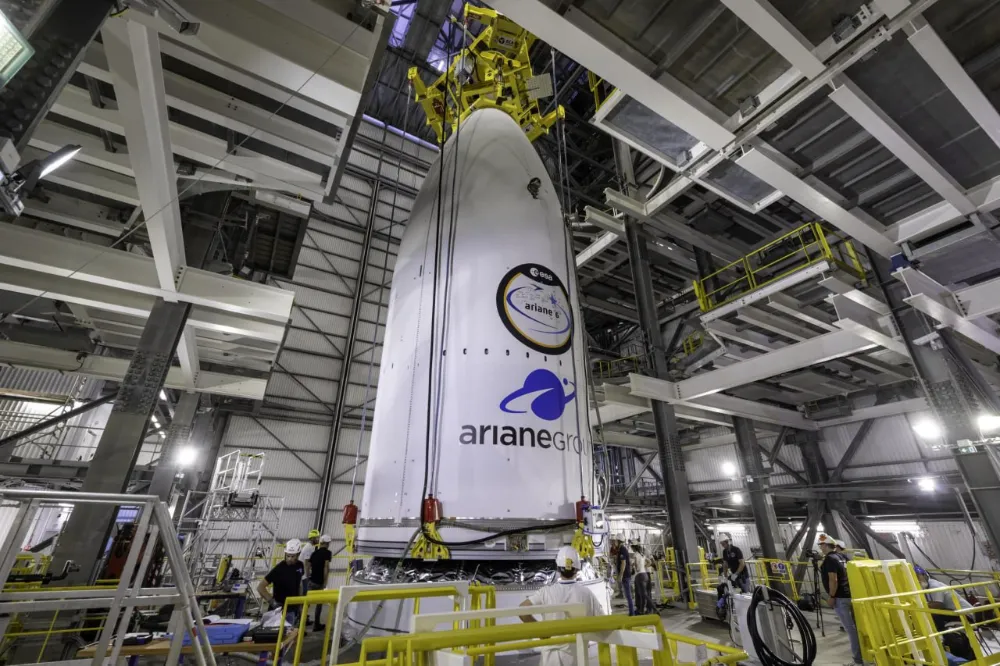
The anomaly interrupts Ariane 6’s production and launch ramp at a critical stage. Europe introduced the rocket in July 2024 as the replacement for Ariane 5, initially flying the two-booster Ariane 62 configuration before expanding operations to include the more powerful four-booster Ariane 64.
Ariane 64 is central to the launcher’s commercial manifest because it can carry large telecommunications spacecraft or batches of low-Earth-orbit satellites. Ariane 62 is intended primarily for institutional, scientific and smaller commercial missions. Both configurations use the same cryogenic core and upper stages, allowing Europe to serve different payload classes within a common launch system.
The reduced 2026 flight count will slow Arianespace’s progress through a manifest that includes European government missions and commercial customers. Amazon has become particularly important to the program, booking Ariane 6 flights for deployment of its low-Earth-orbit broadband constellation and adding six launches in September, bringing its total Ariane 6 commitment to 24 missions through 2031.
Those orders increase the pressure on ArianeGroup’s manufacturing system and Arianespace’s launch operations to reach a higher and more predictable cadence. A single delayed mission can affect subsequent campaigns because rockets share processing facilities, technical teams and launch-pad resources at the Guiana Space Center.
The setback also has strategic implications for Europe. Ariane 6 is intended to restore autonomous access to space after the retirement of Ariane 5, the loss of access to Russia’s Soyuz launchers and delays involving both Ariane 6 and Vega C. Although Europe has again established operational launch capability, increasing the number of annual flights remains essential to serving institutional missions on schedule and retaining commercial customers in a market dominated by higher-cadence providers.
The immediate schedule now depends on the technical assessment of the affected turbopump. Whether engineers approve an on-site repair or require a complete replacement will determine if Ariane 6 can conduct two more missions in 2026 or finish the year with only one additional flight.