SpaceX and Chinese launches dominate this week’s launch manifest, which features six missions from five launch sites worldwide. Falcon 9 is scheduled to launch three Starlink missions from SpaceX’s California and Florida launch facilities. In China, a Chang Zheng 12B flew on its debut mission on Monday, with a Chang Zheng 8 and Chang Zheng 6A set to fly unknown payloads later in the week.
Chang Zheng 12B | Demo Flight
The Chinese Aerospace Science and Technology Corporation (CASC) debuted its latest launch vehicle, the Chang Zheng 12B (CZ-12B), on Monday, June 1, at 08:40 UTC from the LM-12 pad at the Jiuquan Satellite Launch Center in China. Flying on a southern trajectory out of Jiuquan, CZ-12B successfully delivered its payload of two communication satellites for the Chinese G60 constellation to a polar orbit.
The CZ-12B is a 72 m tall, 4.37 m wide rocket capable of lofting approximately 20,000 kg to a 200 km low-Earth orbit (LEO) or 12,000 kg to a 500 km Sun-synchronous orbit (SSO). A two-stage rocket, the first stage features nine YF102R engines that produce 7,515 kN of thrust, while the second stage features a single YF-102V engine that generates 835 kN of thrust. Both stages utilize liquid kerosene (RP-1) and liquid oxygen (LOX) propellants. CASC plans for future CZ-12B missions to feature a reusable first stage that is recovered via propulsive landings, similar to SpaceX’s Falcon 9 and Blue Origin’s New Glenn.
This mission marked the first overall CZ-12B mission and the first of 2026.
Falcon 9 | Starlink Group 10-43
Company News
(adsbygoogle = window.adsbygoogle || []).push({});
The first of three Falcon 9 launches this week is scheduled for Wednesday, June 3, at 4:02 AM EDT (08:02 UTC) from Space Launch Complex 40 (SLC-40) at the Cape Canaveral Space Force Station (CCSFS) in Florida. Falcon 9 will carry a batch of 29 Starlink v2 Mini satellites along a northeastern trajectory to the Group 10 shell of the Starlink constellation.
Falcon booster B1090 will be flying on its 12th mission after a 78-day turnaround and is expected to land atop SpaceX’s east coast droneship, A Shortfall of Gravitas, downrange in the Atlantic Ocean following stage separation. B1090 previously supported the O3b mPOWER 7 & 8, Crew-10, Bandwagon-3, O3b mPOWER 9 & 10, CRS-33, and six Starlink missions.
Falcon 9 is a two-stage partially reusable launch vehicle capable of lofting 22,000 kg to LEO and 8,300 kg to geostationary transfer orbit. Standing 70 m tall and 3.7 m in diameter, Falcon 9’s reusable first stage features nine Merlin engines, while the second stage features a single vacuum-optimized Merlin engine. Both stages utilize RP-1 and LOX propellants.
Falcon 9 | Starlink Group 17-47
The week’s next Starlink mission, Starlink Group 17-47, is scheduled for just a few hours later, at 10:00 AM PDT (05:00 UTC) on Wednesday, June 3. Falcon 9 will liftoff from Space Launch Complex 4 East (SLC-4E) at Vandenberg Space Force Base in California and follow a southern trajectory to Starlink’s Group 17 shell in SSO. Onboard Falcon 9 will be 24 Starlink v2 Mini satellites.
Booster B1088, flying on its 16th mission after a 38-day turnaround, will support the mission and land atop SpaceX’s Of Course I Still Love You droneship downrange in the Pacific. Debuting in November 2024, B1088 has supported the NROL-126, Transporter 12, SPHEREx & PUNCH, NROL-57, and 11 Starlink missions. The booster has spent its entire career at Vandenberg.

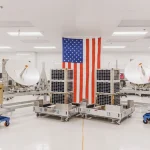
The Starlink satellites before deployment in orbit. (Credit: SpaceX)
Chang Zheng 6A | Unknown Payload
CASC is set to launch a Chang Zheng 6A (CZ-6A) from Launch Complex 9A (LC-9A) at the Taiyuan Satellite Launch Center on Thursday, June 4. Liftoff is scheduled for 11:41 UTC during a 20-minute launch window that closes at 11:51 UTC. The payload being launched is currently unknown but is likely a batch of internet satellites for the G60 constellation.
The CZ-6A is a two-stage medium-lift rocket standing 50 m tall and 3.35 m wide. Capable of carrying 8,000 kg to LEO and 6,500 kg to a 500 km SSO, both stages utilize RP-1 and LOX propellants. The first stage uses two YF-100 engines, generating 2,376 kN of thrust, and the second stage uses a single YF-115 engine, generating 180 kN of thrust.
This mission will mark the 24th overall CZ-6A mission and the fifth of 2026.
Chang Zheng 8 | Unknown Payload
The third and final Chinese launch of the week is scheduled for Friday, June 5, during a four-hour launch window that opens at 04:00 UTC. A CASC Chang Zheng 8 (CZ-8) will carry an unknown payload to LEO along a southern trajectory from Commercial Launch Complex 1 (LC-1) at the Wenchang Space Launch Site.
The CZ-8 is a 3.35 m-diameter, 50.34 m-tall rocket that was first launched in February. The rocket can deliver 8,100 kg to LEO using two stages, with the option to add liquid-fuelled boosters to the first stage. Each booster uses one YF-100 engine, while the first stage uses two. The second stage utilizes two YF-75 engines, burning liquid hydrogen (LH2) and LOX propellants. The boosters and first stage burn RP-1 and LOX.
This mission marks the seventh overall CZ-8 mission and the third of 2026.
Falcon 9 | Starlink Group 10-35
The final launch of the week will see Falcon 9 launch another batch of 29 Starlink v2 Mini satellites into the constellation’s Group 10 shell. Starlink Group 10-35 is scheduled to launch on Sunday, June 7, at 6:30 AM EDT (10:35 UTC) from SLC-40 at CCSFS. The launch window extends for four hours, closing at 10:30 AM EDT (14:30 UTC). Falcon 9 will follow a northeastern trajectory to LEO.
Veteran booster B1067 will set a new flight record, flying for the 35th time following a 69-day turnaround. Following launch and stage separation, the booster will land atop A Shortfall of Gravitas downrange in the Atlantic. B1067 debuted in June 2021 on the CRS-22 mission and has flown the Crew-3, Türksat 5B, Crew-4, CRS-25, Hotbird 13G, O3b mPOWER 1 & 2, Satria, HTS-113BT, Galileo FOC FM26 & FM32, Koreasat 6A, and 23 Starlink missions.
This mission will mark the 648th overall Falcon 9 mission and the 65th of 2026. Furthermore, this mission will serve as the 131st overall orbital launch attempt in 2026.
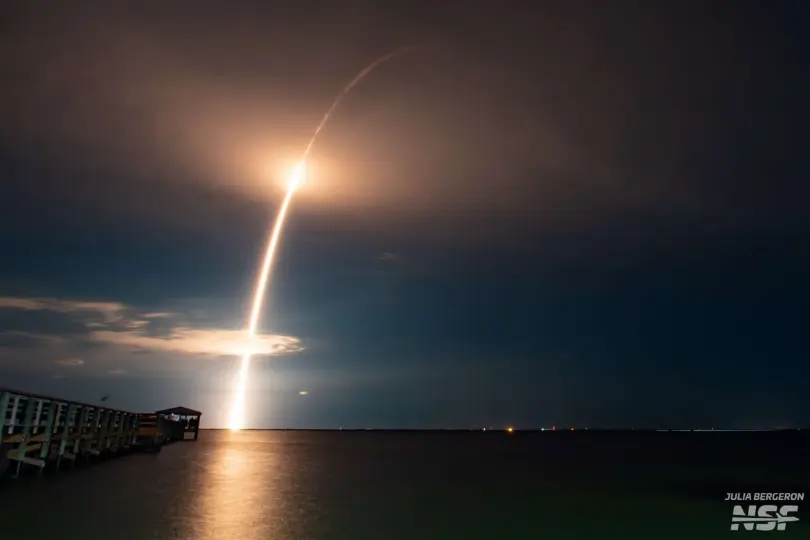
(Lead image: Falcon 9 launches from Florida. Credit: Julia Bergeron for NSF)