
On September 13, during the 2026 China International Fair for Trade in Services (CIFTIS), Beijing Kaiyun United Information Technology Group Co., Ltd. (“Kaiyun Group”), PICC Property and Casualty Company Limited Zhejiang Branch, Beijing Hangbiao Times Testing and Certification Co., Ltd., and Sipai (Beijing) Insurance Brokerage Co., Ltd. signed a strategic cooperation agreement to develop commercial satellite insurance services and establish an ecosystem based on “space data infrastructure AOE + in-orbit risk assessment.”
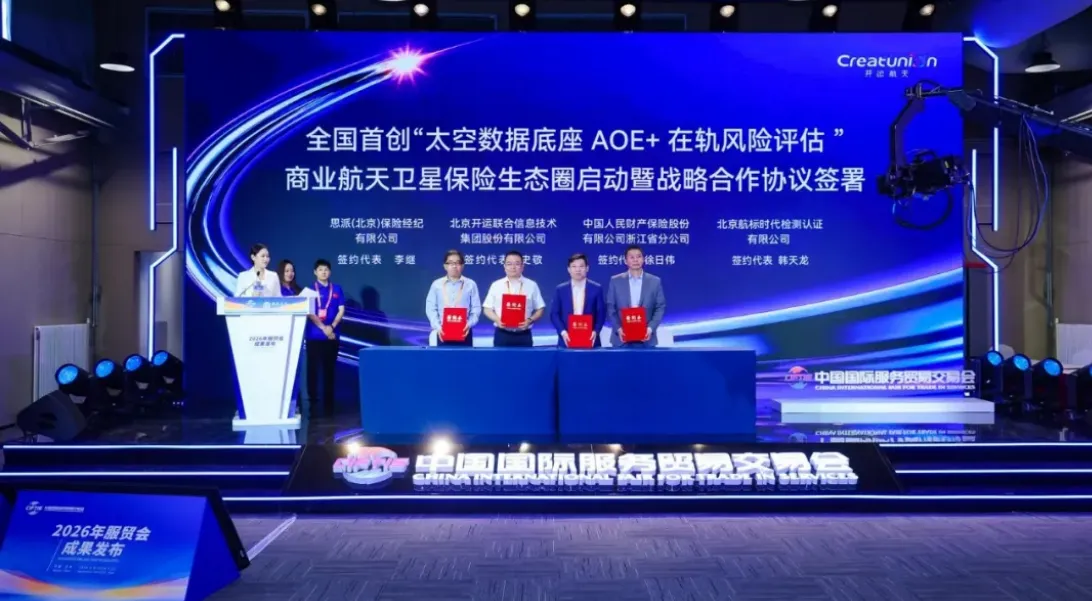
The launch and strategic cooperation agreement signing ceremony for China’s first commercial space satellite insurance ecosystem based on “Space Data Infrastructure AOE + In-Orbit Risk Assessment,” held during the 2026 China International Fair for Trade in Services (CIFTIS).
The initiative incorporates satellite operating status, the space environment, and risk assessment into insurance services, covering pre-insurance risk assessment, in-orbit risk monitoring, satellite health assessment, and loss assessment. In a report published on September 16, China Pacific Insurance said it had co-hosted a seminar during the 2026 CIFTIS on financial and insurance services for the high-quality development of the commercial space sector, highlighting full-chain risk prevention, insurance innovation, and lifecycle risk management.
These developments indicate that attention to risk in the commercial space sector is extending beyond the launch phase to in-orbit operations.
For some satellite projects, the scope of delivery goes beyond simply “putting the satellite into orbit” and extends to completing in-orbit verification and ensuring that the satellite is ready for operations. After entering orbit, a satellite still needs to go through status confirmation, system commissioning, performance testing, and formal acceptance. In other words, a successful launch is only one milestone. It does not necessarily mean that the satellite has already become a space asset ready for operational use.
On August 25, GalaxySpace’s Lingzhi-09 Thai CubeSat was launched aboard the Long March-6C Y1 launch vehicle. According to Xinhua, this was the first time a Chinese commercial space company had completed the development, launch, and in-orbit delivery of a complete satellite for a Southeast Asian country. It was also GalaxySpace’s first export of a complete satellite and ground system, delivered as an integrated solution combining the satellite, ground system, and capability building.
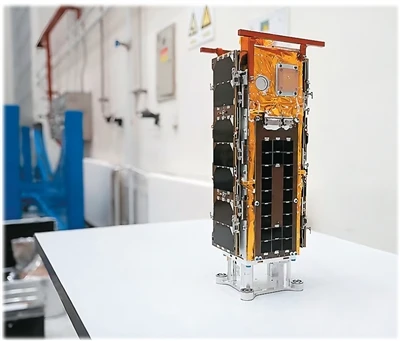
GalaxySpace Lingzhi-09 Thailand CubeSat
In-orbit delivery is not a new model. According to information from the China National Space Administration, the NigComSat-1 project in 2007 marked China’s first export of a complete satellite, providing an international customer with an integrated commercial satellite service covering the launch vehicle, satellite, and in-orbit delivery. China Great Wall Industry Corporation (CGWIC) subsequently carried out a number of in-orbit delivery projects for international customers, including Venezuela, Pakistan, and Bolivia.
So, from successful orbit insertion to final delivery, what key stages does in-orbit satellite delivery actually cover?
A Successful Launch Does Not Mean Delivery Is Complete
The successful completion of a launch vehicle mission does not mean that the satellite is ready for formal delivery. After separation from the launch vehicle, the satellite may still encounter problems such as loss of communications, deployment failures, attitude-control anomalies, insufficient power, or payload malfunctions.
In many turnkey or in-orbit-delivery contracts, it is useful to distinguish three separate milestones:
- Successful launch: The launch vehicle places the satellite into the injection or deployment orbit specified for the mission, or otherwise satisfies the launch-success criteria defined in the contract;
- Completion of in-orbit commissioning: Ground teams establish communications with the satellite and, as required by the mission, complete activities such as deployment, attitude acquisition, orbit adjustment, and payload activation so that the satellite enters normal operating status;
- Completion of in-orbit delivery: The satellite passes the tests and acceptance procedures specified in the contract, after which any systems, documentation, title, control, possession, or other deliverables covered by the contract are transferred in accordance with its terms.
These milestones may be separated by several weeks or longer. The actual timeframe depends on the satellite type, mission complexity, and the testing and acceptance arrangements specified in the contract.
Delivery Requirements Need to Be Defined Before Launch
Although the term “in-orbit delivery” refers to activities conducted in orbit, preparations for delivery actually begin much earlier in the project.
Public materials from Changguang Satellite show that its whole-satellite business starts with customer requirements analysis, followed by overall mission and system design, reviews, and product development before proceeding to launch, in-orbit verification, and delivery for use.
This means that before launch, a project needs to clarify two things: what ultimately needs to be delivered, and how it will be determined whether the satellite meets the delivery requirements.
For Earth observation satellites, these requirements may include imaging capability, coverage, revisit capability, and data transmission. Communications satellites and other satellite types have their own functional and performance requirements. The specific indicators and acceptance procedures depend on the mission objectives and contractual terms.
If these requirements are not clearly defined in the contract and technical documentation, even a successful orbital insertion may leave the two parties without a common basis for formal acceptance.
Launch Integration Is Also an Important Part of the Delivery Chain
After the satellite has been manufactured, it must still go through launch integration before entering the launch phase.
This stage involves numerous interfaces among the satellite, launch vehicle, launch site, and ground TT&C system. It also requires technical configuration checks, environmental compatibility assessments, and mission preparations.
Schedule management is itself a risk factor. If satellite development is delayed, the project may miss its planned launch window. If the launch vehicle or launch schedule changes, the satellite may need to remain in storage for longer and undergo additional testing or configuration maintenance before the next launch opportunity.
For one-stop delivery projects, the system integrator typically needs to coordinate the satellite manufacturer, launch vehicle provider, launch site, and TT&C organizations so that the different parts of the project remain aligned around the same launch and delivery schedule.
Launch remains one of the stages where satellite project risks are highly concentrated.
Depending on the policy wording, launch and early-orbit insurance may cover launch failure, failure to reach the specified injection or operational orbit, orbit raising, in-orbit testing, commissioning, and total or partial loss during the insured period. Third-party liability insurance responds to specified legal liabilities to third parties; depending on the jurisdiction and policy, these may include damage to people or property on Earth, aircraft in flight, and in some cases other space assets.
The launch failures of the Jilin-1 Gaofen 02C and 02E satellites provide a practical example disclosed by Changguang Satellite.Changguang Satellite disclosed that it received RMB 60 million and RMB 40 million in insurance proceeds, respectively, for a total of RMB 100 million.
Insurance, however, addresses who bears the financial loss, while the delivery contract must also address how the project is to be completed.
For example, whether a failed launch requires the satellite to be rebuilt, how a replacement launch is arranged, who bears the associated costs, and how delays are handled all depend on the specific contract and insurance arrangements.
Insurance therefore cannot directly replace delivery obligations. The two address different aspects of the project: insurance transfers financial risk, while the delivery contract governs project performance and completion.
For customers without an independent launch procurement and mission assurance team, this cross-system coordination can itself be an important component of one-stop delivery.
Launch and Early Orbit Phase: The First Test After a Successful Launch
After separation from the launch vehicle, the satellite enters the Launch and Early Orbit Phase, or LEOP.
During this stage, the necessary in-orbit operations are performed to gradually bring the satellite into an operating state suitable for subsequent testing.
APSTAR-6C provides a public example. Launched on May 4, 2018, the satellite entered LEOP, carried out multiple engine burns and orbit adjustments, then moved into its designated test position for in-orbit testing before continuing to its final geostationary orbit position.
The main questions at this stage are:
Has the satellite reached the expected operating state?
Is it ready to proceed with subsequent testing?
Depending on the mission, early in-orbit operations may also include establishing communications between the satellite and ground, deploying solar arrays and antennas, establishing attitude control, configuring onboard systems, and activating payloads.
Potential problems during this phase include failure to establish communications, deployment failures, attitude-control anomalies, power or thermal-control issues, failure to reach the operational orbit, and payload startup failures.
A successful launch therefore confirms that the transportation phase has been completed, but does not by itself demonstrate that the satellite is ready to perform its mission.
In-Orbit Status Monitoring: Confirming That the Satellite Is Operating Normally
Satellite status monitoring begins during LEOP and continues through subsequent testing, acceptance, and operational handover.
Changguang Satellite has publicly described in-orbit delivery activities including satellite status monitoring, anomaly reporting, and mission execution management. Its teams also use satellite tracking systems to monitor the spacecraft and review TT&C and telemetry/data transmission information to identify potential abnormalities.
These activities address several basic questions:
Where is the satellite?
Is its operating status normal?
Are TT&C and data transmission functioning properly?
Are there any anomalies that could affect mission execution?
For equipment on the ground, engineers can directly inspect the hardware. Once a satellite is in orbit, however, many operational judgments must be made through TT&C, telemetry, and data transmission information.
Continuous visibility into satellite status is therefore a foundation for subsequent in-orbit testing and formal acceptance.
In-Orbit Testing Must Demonstrate That the Satellite Can Perform Its Mission
A satellite operating normally does not necessarily mean that delivery is complete.
The next step is to compare the satellite’s actual in-orbit performance with the mission requirements established before launch.
For an Earth observation satellite, several practical outcomes are typically important: whether the satellite can consistently perform observation tasks, whether the payload is functioning properly, whether the imagery and data meet the required standard, and whether the data can be successfully transmitted back to the ground.
For communications satellites, the focus may instead include communications links, coverage, and capacity, depending on the mission.
On June 4, 2018, APSTAR-6C completed all planned in-orbit tests, and CGWIC submitted a comprehensive in-orbit test report to the customer. The project subsequently passed its in-orbit acceptance review.
The Sustainable Development Science Satellite 1 (SDGSAT-1) provides a further example showing that in-orbit testing can cover not only the satellite itself, but also the ground system and the integrated space-ground system. According to public information from the Chinese Academy of Sciences, the satellite completed testing of the satellite system, ground system, and space-ground integration. It was operating stably and in good condition, with all functions and performance meeting the overall development requirements. After completing six months of in-orbit testing, it was formally delivered for operational use.
In other words, in-orbit testing is ultimately intended to confirm:
Whether the satellite itself can operate normally;
Whether the payload can perform its mission;
Whether data can be acquired and transmitted properly;
Whether the integrated space-ground system can operate as intended.
The scope and duration of testing vary from one satellite to another and are determined by the mission objectives and project contract.
Acceptance and Transfer: Completing the Delivery
Where the contract provides for formal acceptance, completion of testing is followed by the applicable review and acceptance procedure.
APSTAR-6C illustrates this sequence. After the satellite completed all planned in-orbit tests, CGWIC submitted a comprehensive test report to APT Satellite. The subsequent in-orbit acceptance review was completed successfully, and ownership of APSTAR-6C was transferred to APT Satellite as part of the in-orbit delivery.
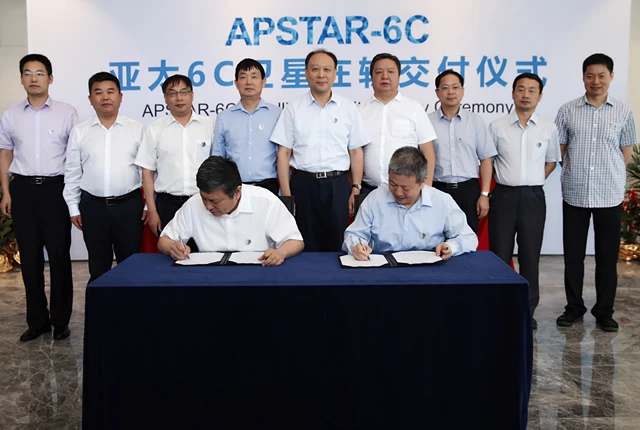
On August 7, 2018, China Great Wall Industry Corporation (CGWIC), a subsidiary of China Aerospace Science and Technology Corporation (CASC), and APT Satellite Company Limited (APT Satellite) jointly held a ceremony to celebrate the successful in-orbit delivery of the APSTAR-6C satellite to the customer.
Public contract documents for APSTAR-6E further illustrate what such a delivery milestone can mean. The project links In-Orbit Delivery to final acceptance, with ownership, control, and possession of the satellite and related deliverables transferred at the delivery milestone in accordance with the contract. The associated risks and insurance interests also change accordingly.
Based on these public projects, in-orbit delivery can be understood as:
LEOP and initial spacecraft acquisition → commissioning and orbit acquisition → in-orbit testing and space-ground validation → discrepancy resolution → formal acceptance → contractual transfer into operational service.
Satellite status monitoring continues throughout these stages rather than forming a single standalone step.
This is not a fixed process that applies identically to every commercial satellite. The specific tests, timing of acceptance, and the point at which ownership, control, and related risks are transferred all depend on the terms of the inpidual project contract.
Delivery May Involve More Than the Satellite Itself
A satellite may be fully operational, but without compatible ground infrastructure and trained personnel, it may still be difficult to turn the spacecraft into an operational service.
As a result, for some international projects, in-orbit delivery can also extend to ground systems, personnel training, and initial operational support.
The NigComSat-1 project, for example, included not only the in-orbit delivery of the satellite, but also the delivery of a tracking station in Kashgar, Xinjiang, and a fully operational ground station in Abuja, Nigeria, together with a 15-year operational support service and a comprehensive technical training program. CGWIC described it as the first comprehensive in-orbit delivery satellite project provided by China’s space industry to a foreign customer.
The recent Lingzhi-09 project followed a similar integrated approach combining the “satellite + ground system + capability building.” Public information indicates that after entering orbit, the GISTDA ground station in Si Racha, Chonburi, Thailand, established contact with the satellite and received signals.
The satellite is planned for applications including agriculture, vegetation, forests, water resources, and land-use change monitoring. It will also support Thai personnel in learning about satellite mission design, assembly and testing, TT&C, and remote sensing applications.
China’s earlier Pakistan Remote Sensing Satellite-1 project also adopted a similar arrangement. In addition to in-orbit delivery of the satellite, the project included a ground application system, ground TT&C system, in-orbit testing, on-site support, training, insurance, and related technical services.
These projects show that, in some turnkey satellite programs, the final deliverable is not simply a spacecraft that has reached orbit, but a complete system that the customer can take over, operate, and use.
For customers building their own national space capabilities, the ability to control the satellite, receive data, train personnel, and put the resulting data into practical use can be as important as the satellite itself.
As Delivery Extends Into Orbit, Risk Management Covers This Stage as Well
Returning to the commercial space insurance cooperation announced on September 13, this shift becomes easier to understand.
If a satellite still needs to operate, be monitored, undergo performance verification, and be managed over the longer term after entering orbit, then its risks do not simply disappear once the launch is complete.
The “space data infrastructure AOE + in-orbit risk assessment” cooperation launched on September 13 is intended to combine an integrated observation network and third-party space situational awareness data with in-orbit risk assessment, supporting collision alerts, orbital-status monitoring, and risk evaluation.
China Pacific Insurance likewise identified full-chain risk prevention and lifecycle risk management as important areas for financial and insurance services supporting the commercial space sector.
These developments indicate that the scope of insurance attention is gradually becoming more closely aligned with the actual operating lifecycle of satellites.
For delivery, status monitoring, in-orbit testing, and acceptance are needed to confirm that a satellite has reached the agreed delivery conditions. For risk management, continuous monitoring of the satellite and its operating environment is needed to identify and assess risks that may affect its operation.
The two address different questions, but both point to the same stage:
A satellite still needs to be continuously managed after it enters orbit.
From “Launching a Satellite” to “Delivering an Operational Space Asset”
Taken together, the process of a satellite mission can be broadly described as:
Requirements and acceptance definition → mission and system design → satellite development and ground testing → launch integration → launch and separation → LEOP → commissioning and orbit acquisition → in-orbit testing and space-ground validation → discrepancy resolution → formal acceptance → contractual transfer → operational support
Status monitoring and risk management continue across all post-launch stages.
Launch is an important milestone, but it is not the endpoint of delivery.
From early orbit operations and status monitoring to in-orbit testing and final acceptance, the party responsible for post-launch delivery under the contract must continue to complete the agreed activities until the satellite satisfies the contractual delivery conditions.
In some turnkey projects, the scope can extend further to ground systems, training, and operational support.
The essence of in-orbit delivery, therefore, is to take a satellite that has already reached orbit, complete the necessary operations and verification, and ultimately deliver it as a space asset ready for formal operational use.
For organizations planning a satellite project, the practical question is therefore not simply how to reach orbit, but what capabilities must be ready when the system is handed over: validated spacecraft performance, compatible ground systems, workable operating procedures, and personnel able to use them.
STARPATH GLOBAL helps international customers translate these operational objectives into requirements for payload customization, AIT, delivery support, and capability building, drawing on China’s expanding satellite supply capacity to provide cost-competitive project options. Organizations that do not yet have an experienced satellite or remote sensing team can apply to the Pioneer Partner Program, where the STARPATH GLOBAL FDE team supports requirements definition, project implementation, and personnel training. To assess the scope and delivery path of a planned mission, international customers can contact STARPATH GLOBAL and discuss an approach matched to their intended applications and operational capabilities.